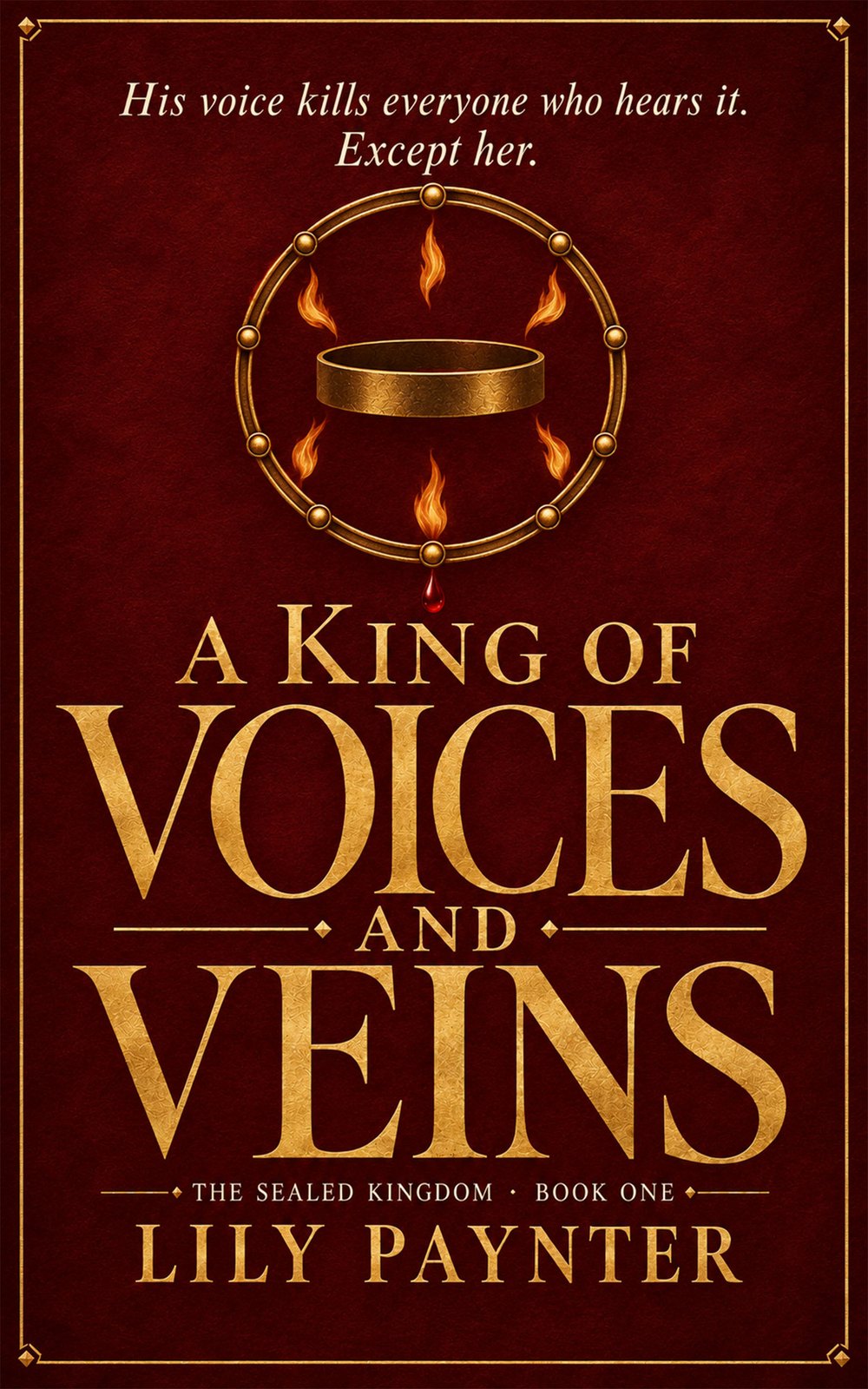
The Sealed Kingdom · Book One
A King of Voices and Veins
His voice kills everyone who hears it. Except her.
A slow-burn, open-door romantasy.
Coming 7 February 2027
The Book
His voice kills everyone who hears it. Except her.
Linnet Fane has trained for eight years to become a physician, and she has five coins to her name. On the afternoon of her final exam, the king speaks in the hall where she is working, and she has no wax in her ears. She hears every word. She lives.
Nobody is supposed to survive King Corvane’s voice. Now he wants her beside him, the only person in the kingdom he can talk to. The priests want her mouth sealed shut. And a preacher in the streets has started calling her sister.
Something woke in Linnet the day she heard the king, and it is getting stronger. The closer she gets to him, the more she wants him, and the more she wonders whether he knows exactly why she lived.
With an enemy army waiting for the river to thaw, Linnet has to decide what she is, who she will stand beside, and what she will do with a voice that can stop a heart.
A King of Voices and Veins is Book One of the Sealed Kingdom trilogy: a slow-burn, open-door romantasy with a dangerous king who cannot speak without killing and a heroine who refuses to be kept. The romance in this book ends happily. The wider story continues in Book Two.
Read the Opening
Chapter One
The king’s voice kills anyone who hears it. On the afternoon of my assessment, I heard every word he said, and I lived.
A hundred pairs of wax plugs hung on hooks under the arch of the assessment hall, so that anyone in the room could get the wax in before the king was through the door, if he ever came. He never did. Kings do not visit the physicians’ school. But every child in Rhune knows why the plugs are there. Through wax, you hear a third of his voice, and you live. A third of the king is enough for anyone. The Keeping teaches it, and nobody doubts it.
The hall was the coldest room in the school, and I had always believed that was deliberate. It smelled of lye and old blood, like everywhere I had ever worked.
I had eight years of work behind me, five coins left in my purse, and one chance to pass. I should have sat it the year before, and hadn’t had the fee. The patient on my table was a volunteer from the laundry, paid a silver piece to let a student slow her heart and bring it back. My hands were steady. That was the only thing I had that the other candidates didn’t. No family, no name, no letters from anyone important. Just steady hands. I had watched the candidates with letters stitch. I wouldn’t have let two of them near a dog.
“Pulse,” said Adei, from the end of the table.
“Forty. Falling.” It was falling exactly as fast as I meant it to, and I was enjoying myself. I reached for the dose that would bring her heart back.
The doors at the end of the hall slammed open so hard that one of them cracked against the wall.
Not now, I thought. Not during my assessment.
Two porters came through at a run with a man slung between them. Blood had soaked his shirt from the ribs to the knee, and his skin had gone the gray-white of a man whose body had started dying without him.
“Physician!” the younger porter shouted. He was a boy of about seventeen, all freckles and elbows, with a tin of wax bouncing on a string at his belt. “Please, he’s going—”
I got the dose into the volunteer’s arm, felt her pulse kick back under my fingers, and swept the practice tray off the next table with my forearm to make room. Glass broke on the floor. Something sliced across the pad of my thumb, a small bright sting. I ignored it.
“Here. Put him here.”
The wound was high in his side, deep and ragged, and it was pumping. Not welling. Pumping. Every beat of his heart was emptying him onto the table.
I put my fingers into the wound and found the artery by feel, hot and slick, jumping against my fingertips. I pinched it shut.
The pumping stopped.
My mother had burned with a fever nobody in Harl knew how to break. I had been fifteen and useless. I was not useless now.
“Good,” Adei said, at my shoulder. She was the senior physician on my assessment, a small, dry woman who had told me exactly twice, in all my time at the school, that I had done something right. I could have given her the dates. This made three. “Hold that.”
“You’ve got steady hands, miss,” the freckled porter said, breathless. “He’s lucky it’s you.”
“Tell him that when he wakes up,” I said. It was the nicest thing anyone had said to me all year, and he was standing in my light.
Then I felt something under my fingertips that should not have been there. Grit. Fine and dark, working its way out of the wound with the blood.
I had seen that powder once in my life, behind glass in a locked case. Cinderrock. If it gets into a wound it eats the body from the inside, faster than any fever, and every physician in Rhune learns on her first day that there is no cure for it.
Except one, and no physician had it.
“Cinderrock,” I said.
Adei’s head came up. For the first time since I had known her, she was afraid.
“Send for the king,” she said.
“Ears!” someone shouted. The hall broke into motion, and everyone went for the wax.
“Wax in,” Adei said. She pushed two plugs of wax into the dying man’s ears with her thumbs, quick and neat, did her own in the same breath, and was already reaching for me with another pair from her apron.
Under my fingers, the artery jumped. Lower down, below my hand, the wound had started bleeding from a second place, and faster.
“Fane. Hold still,” Adei said.
I pulled my head away from her hands.
“Not me. There.” I nodded at the welling place under my wrist. “Pack it. Now. If you stop to do my ears, he’s dead before the king’s through the door.”
“Fane—”
“I can’t let go,” I said. “And neither can you.”
Adei knew it as well as I did. She had taught it to me.
“If he speaks,” she said, “you will be dead.”
My heart was going so hard I could feel it in my teeth. I thought about my five coins. I thought that at least I would not be there to fail my assessment.
“Then I’ll be dead,” I said. “Pack it.”
She held my eyes for one more second. Then she put the wax down on the table, took a pad of linen from her apron, packed it into the wound beside my fingers and pressed. The lower bleeding slowed. We stood there together, her hands and mine inside a stranger’s body, her ears full of wax, mine bare, and nothing between me and the door.
I had stood at a bedside once with empty hands. I was not going to do it twice.
The freckled porter was still beside me, fumbling his second plug of wax with shaking fingers. I told him to get back, away from the door. In the noise, with one plug in and his hands shaking too hard to manage the other, let alone mine, he didn’t hear me. Nobody else came near me. Everyone in the hall who could move had backed to the walls with their own hands over their ears.
I don’t know how long we held him. Long enough for the blood to come through the packing twice. Long enough to stop hoping it would be quick.
The doors opened.
I had never seen the king. I had imagined someone old, someone in gold. The man who came through the door was neither. He was tall and dark and very still, in a plain black coat with no crown, and the hall went silent around him like a field when a hawk crosses it.
He came straight to the table. Two men came with him, and the room parted for all three. Up close he was younger than I expected, older around the eyes. He looked at the wound, at my fingers inside it, and then, for one moment, at me.
I had been looked at all my life by people deciding what I was worth. No one had ever looked at me like he did: a problem he had not been told about and did not have time for. He hadn’t looked at the dying man’s face once. I marked that against him.
He held out his left hand, and one of them drew a small knife across it. The king turned his cut palm over the wound. His blood ran down into it, dark and quick, over my fingers and over the cut on my thumb that I had forgotten about. It was warm, and it stung in the cut. I had my hands in blood every day, and none of it had ever stung like this.
The artery began to slip under my fingertips. The king’s blood wouldn’t close the wound until he spoke, and I was losing my grip.
The other man had a plug of wax in his fingers and was reaching across the table for my ear, a breath too late.
Every other ear in the hall was plugged, or nearly. Mine were bare.
The king saw the wax in the other man’s fingers, and the artery slipping under mine, and he didn’t wait. He said, “Don’t let go.”
Every candle in the hall leaned toward him.
Forty flames along the walls, all at once. The water glasses on the tables began to hum.
And his voice went into me.
I heard it, but hearing was the smallest part. It came in through my ears and did not stop there. It went down through my throat and settled in my chest, low and warm, the way the sun gets into a stone wall. Then it moved. Out along my shoulders, down my arms, into my wrists, into my hands, until it was in the very fingers that were holding a dying man’s life shut, and I could feel it there, under my skin, as clearly as his pulse.
It was not loud. That was what I had not expected. I had grown up on stories of his voice as a roar, a blast, a thing that broke people like glass. It was none of that. It was low and plain and close, like words said against my neck. I could hear the breath in it, and that his throat was dry. Under the three words, I could hear that he was tired, and that he had said a great many things in his life that he could not take back. It was not the voice I would have given that face.
No one had ever been that close to me. Not my mother. Not anyone. A stranger had put three words inside my body, and they were not about the kingdom, or the law, or me. They were about my hands.
Don’t let go.
I didn’t.
Beside me, something fell.
The freckled porter had dropped his tin. He had one plug in his ear and the other on the floor, and he was standing straight, mildly surprised, like someone hearing his name called from a long way off. His knees folded and he went down onto the stone. He was dead before I could take my hand out of the wound.
I couldn’t go to him. He had been standing in my light. I looked at him, and he looked at nothing, and the candles straightened along the walls.
Under my fingers, the artery stopped fighting me. The torn edges drew together, slick and warm, like a seam being sewn from the inside. The grit stopped coming. The man on the table took a breath, a real one, and his face began to color from the neck up.
I let go.
I took my hand out of him, covered to the wrist in two men’s blood, and I was alive. My hands had started to shake, now that there was nothing in them to hold.
The hall stayed quiet, and now the quiet was about me.
At first they were all looking at the porter on the floor. Then one woman turned and stared at the side of my head. At my ears. My bare ears, with no wax in them, and nothing running out of them, and nothing wrong with me at all.
She put her hand over her mouth.
It went around the hall like fire. One face, then three, then all of them, silent and white, with wax in their ears.
One of the two men had gone still. He wore the gray of the Keeping, the priests who guard the king’s voice and the laws around it, and he was looking at me the way I had looked at the cinderrock.
His wax was still in. He hadn’t needed to hear anything to see it. “She heard him,” he said, too loud, and then to the hall: “Anyone who hears the king whole is a heretic. By law.”
Everyone in Rhune knew that law. It had never touched anyone, because no one had ever heard the king whole and lived.
I had walked into that hall the best candidate in it. Now the people nearest me had stepped back, as you step back from a spill. I wanted, absurdly, to point at the man breathing on my table. I had done that. Did it count for nothing?
The king had not moved. His eyes were back on me, and this time I was not a problem he had no time for. I was a problem he had never seen before.
He spoke to me, in the same low voice.
“Can you hear me?”
Half the hall flinched. Adei had stepped back from the table, and she put both hands over her ears, over the wax.
The words landed in my chest and stayed there, warm, like a hand laid flat.
“Yes,” I said.
“What did I say to you?”
“Don’t let go.”
His eyes went to my bare ears, and down to my hand, red to the wrist, and back to my face. Something moved in his face, too fast to read. Then he was what he had been when he walked in: still, cold, and considering me as if I belonged to him now and he had not yet decided what to do with me.
He turned to the men behind him.
“Bring her.”
Keep reading: Chapter Two
Chapter Two
They put me in a room at the top of a stair, somewhere in the palace, and no one spoke to me.
That was the first thing I learned about being a heretic. The guards who brought me there wore wax. The maid who brought me a basin of water wore wax and kept her eyes on the floor. She backed out of the room without turning her back on me. Not one of them said my name. They looked at my bare ears and then away, like people turning from a wound they don’t want to treat.
I washed the blood off my hands. It took three changes of water. There was a small cut on the pad of my thumb, already closing, and I didn’t think about it.
I thought about the porter instead. I didn’t know his name. I had told him to get back, and he hadn’t heard me, and then he had heard the king.
I thought about the voice. I had heard him and I was alive. No one could tell me why. Three words. I could still feel where they had gone.
Someone had left a nightdress on the bed, of better linen than anything I owned. I put it on, because my own dress was stiff with blood, and resented how soft it was.
I sat on the edge of the bed in a borrowed room with my hands clean and nothing to do with them, and that was the worst of it. On the ward there was always a next thing. Here there was a basin and a barred door, and nothing in the room that needed me.
I made myself think like a physician, because it was the only way I knew how to think. Two people had heard the king. The porter had one ear open; I had two. His hands had been shaking; mine had been inside a wound, holding an artery shut, with the king’s blood running over them. He had died in a breath. The voice had come into me and gone down through my chest into my hands, and done nothing to me but settle. It was still there, like something that had found its place. I couldn’t find a single sign of harm. That was the whole of my examination, and it told me nothing except that the Keeping was wrong about the law, or I was something the law had never met. Neither of those was going to get me back to the Low Ward by morning.
If it had happened to anyone else, I would have been sitting beside them with a pen, asking them everything.
I wanted my ward. I wanted Adei’s voice at my shoulder telling me I’d done something right. I wanted the assessment I had worked eight years for and would never now sit. I was angry, and under the anger I was frightened, and under the fear, where I didn’t want to look, was the place his three words had gone, still warm. I didn’t understand how a thing could frighten me and steady me at the same time, and I wasn’t going to think about it in a room where anyone might come through the door.
They came for me late that night.
I wasn’t asleep. I heard boots on the stair, more than two pairs, and the scrape of the bar on the outside of my door. Then the door opened, and the room filled up with gray.
There were five of them. Four were young men in the plain coats of the Keeping, with wax in their ears and their sleeves rolled to the elbow, ready for messy work. The fifth was old. He had a narrow face and a thin chain of office around his neck, and he held a lamp up to my face.
“Linnet Fane,” he said. “I am the Warden of the Keeping. You have heard the king’s voice whole. You will come with us to the silent house.”
I had heard of the silent house. It sat on the hill above the river, and the people who went into it lived there in silence until they died, so that whatever the king’s voice had left in them went no further. Beside its single small door was a shelf where the city left bread, and nobody ever knocked.
“For how long?” I said.
He heard me well enough. “For life.”
Two of the young men came forward and took my arms.
I didn’t decide to fight. My body decided for me. I twisted my right arm free and drove my elbow back into something soft. Someone grunted. Then there were more hands. The bed went over, the basin went over, and I was on my knees on a wet floor, in my nightdress, with my arms pulled up behind me so hard my shoulders burned.
“Gently,” the Warden said, without much interest. “She is a physician. She knows where to hurt you.”
They put a hood over my head. It smelled of someone else’s breath.
That was when I was afraid. It wasn’t the men, or the hands, or the Warden’s lamp. It was the hood: the dark inside it, and the sound of my own breathing, too loud, too close, and the thought that this was what my life would sound like from now on. My own breath, and no other voice, for forty years.
I stopped fighting then, because I couldn’t see, and some cold, practical part of me had started counting. Down the stair: thirty-one steps. A long corridor, stone under my bare feet. Past the palace guards, who stood aside. Someone had told them to. Then night air, river air, a horse stamping, and the creak of a carriage on its springs.
They were going to put me in that carriage, and I was never going to come out.
“Stop.”
It was one word, and it was not loud, and every man holding me stopped.
I knew that voice the way you know your own hand. Even through the hood it found me, and something that had been clenched in me since the stair finally let go. I was glad of him now, and I didn’t enjoy being glad.
When the hands on my arms loosened, my legs went with them, and I was on my knees on the cobbles. The men holding me hadn’t chosen to let go. They had wax in, and even a third of that voice, when he drives it, is enough to make a man’s hands forget what they were doing.
Someone pulled the hood off.
The king was standing in the middle of the courtyard. He wasn’t dressed for the cold. He had no coat, only a dark shirt open at the throat, and he had come alone. The torches along the walls were leaning toward him, all of them, every flame bent the same way.
He looked at the Warden, not at me.
“This woman is Physician to the Crown,” he said.
Physician. That was the word I had gone into the hall to earn, and I had not earned it.
The Warden’s mouth thinned. “Majesty. She heard you whole. The law—”
“The law gives her three Silences.” His voice didn’t rise. “She will be examined three times, by the Keeping, before witnesses. If she fails, she is yours. Until then, she is mine.”
I was still on my knees. I lifted my face to him, and he still did not look at me.
“Majesty,” the Warden said, “the Silences are for those who may have heard you. Not for those who certainly did.”
“She is Physician to the Crown,” the king said again. “The Crown’s physician answers to the Crown. Take your hands off her.”
They took their hands off me.
The Warden looked at the king, and the king looked at the Warden. I knelt between them on the wet stones with my nightdress soaked to the knee, and understood that I was not part of this conversation at all. I was the thing they were arguing over. A coat on a hook, with two men’s hands on it.
The Warden bowed, barely.
“Three Silences,” he said. “The first in eight days, Majesty. As the law requires.”
“As the law requires.”
There was nothing in the Warden’s face I liked. He turned and walked to the carriage. His four young men went after him, one of them holding his ribs where my elbow had been.
The carriage pulled away.
He could have dropped all five of them with a word. He had quoted the law at them instead.
I got to my feet. My knees hurt. My shoulders hurt. I was shaking so hard I had to hold my own elbows to stop it showing.
“Thank you,” I said.
He looked at me then, for the first time. In the torchlight his eyes were dark and not at all kind.
“Don’t,” he said. “I didn’t do it for you.”
I had meant it. He handed it back to me like a bad coin.
“Then why?”
“Because you are of use to me.” He said it the way you might say a horse was sound. “You will live in the tower, where I can see you. You will go nowhere without a guard. You will not speak to the Keeping, or to anyone from your school, or to anyone who asks you what you heard.”
“I’m not a prisoner.”
“You were about to be, for the rest of your life.” He tilted his head slightly. “Would you prefer the carriage? It hasn’t gone far.”
I didn’t answer that.
I wanted to. I wanted to tell him that I had spent every year since my mother died and every coin I had to become a physician, so that I would never have to belong to anyone, and that he had just told a courtyard full of strangers that I was his. I wanted to tell him he could keep his tower.
But I could still hear the carriage wheels.
“Good,” he said, as if I had spoken. Maybe my face had. “Someone will take you up.”
“I want my instruments,” I said. “I’m no use to you without them.”
“Then someone will fetch them.”
He turned to go.
“Why am I alive?” I said.
He stopped and turned, and looked at me properly, the way he had in the hall.
“That,” he said, “is what I mean to find out.”
“When you do, will you tell me?”
“If it’s any use to you.”
“It’s my life.”
“Yes,” he said. “And as of tonight, it’s my problem.” He looked at my bare ears, and then at my mouth. “There was wax on the table beside you. Why didn’t you use it?”
“Because I’d have had to let go.”
“You saw my ears were bare,” I said. “You spoke anyway.”
“The artery was sliding,” he said, “and the wax was a breath away. I chose him.” A pause. “I would again.”
I had chosen the man on the table too. But I had been choosing what to do with my own life. He had been choosing what to do with mine.
He looked at me a moment longer than he needed to, then away. “Eight days, Physician. I suggest you learn to look as if you can’t hear me.”
That’s the end of the free sample. Book One is coming 7 February 2027.
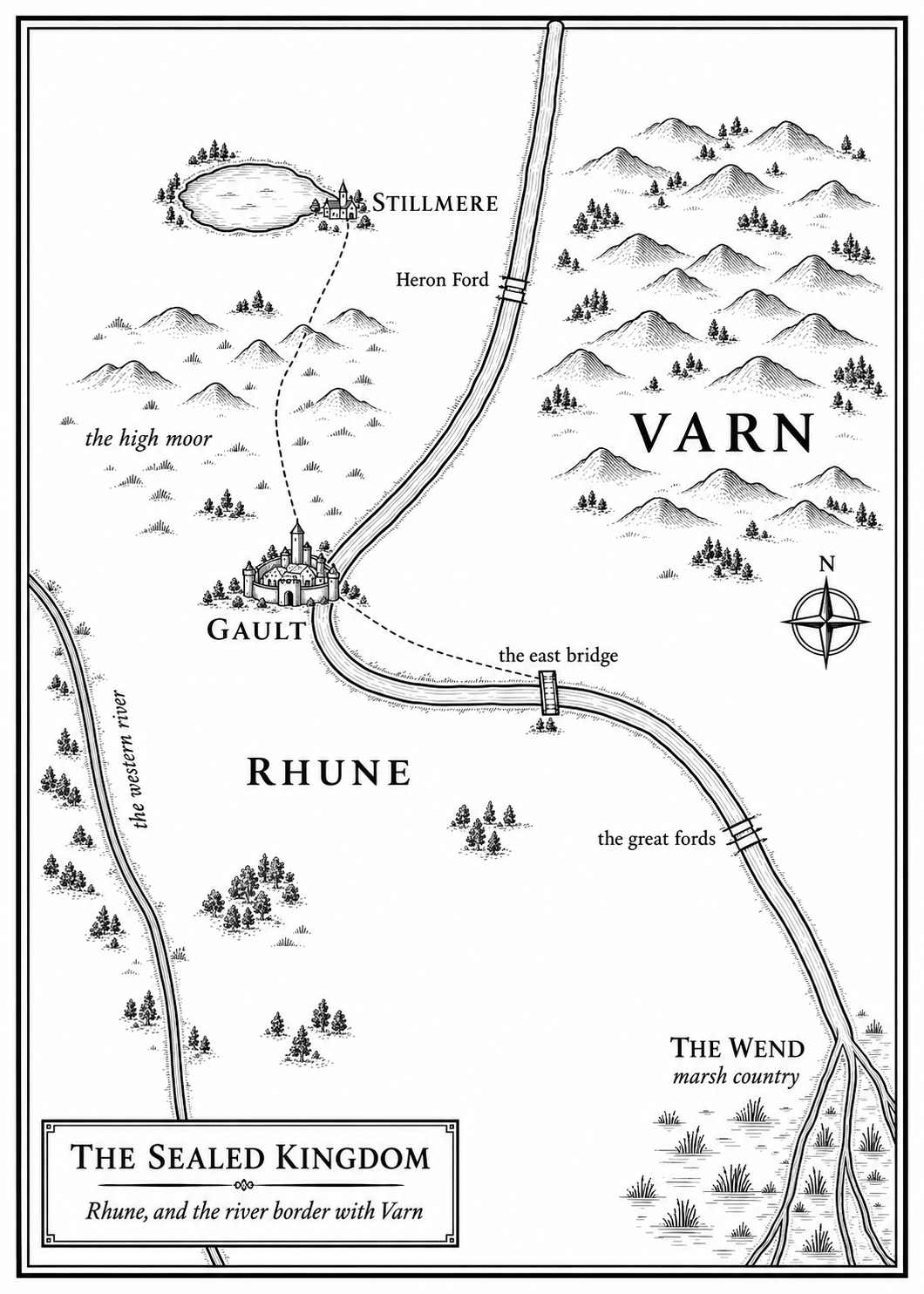
The Map
The Sealed Kingdom
A trilogy of slow-burn, open-door romantasy.
Book One
Coming 7 February 2027

Book Two
Coming 2027
Book Three
Coming soon
About Lily
Lily Paynter believes an author should be read, not seen or heard, and that nothing good comes from meeting your heroes. So there is no photo and no appearance, only the books.
She writes slow-burn, spicy romantic fantasy about dangerous men, women who refuse to be kept, and kingdoms that try to keep them apart. Her first series is The Sealed Kingdom.
Content notes for A King of Voices and Veins
This book is for adult readers. It contains open-door love scenes between consenting adults, the on-page deaths of loved characters, battle violence and injury, the killing of civilians, medical scenes including a difficult birth and surgery, poisoning, arson, kidnapping, an attempted hanging, a cult that cuts and kills its captives, magic that takes control of a person’s body and voice, and a character bound and gagged.